 Easy read and translate



De Quervain's syndrome
Understanding De Quervain's syndrome
De Quervain's syndrome describes a painful restriction of 2 of the tendons that attach muscles to your thumb. These tendons can usually slide smoothly through ligament sheaths which hold them in place.
When you have De Quervain's syndrome there is a thickening of these ligaments causing resistance.
This usually occurs as an overuse injury where there is repetitive use of the thumb.
Treatment options for De Quervain's syndrome
The main aim of treatment is to allow the tendons to settle down again and stop being painful. The most effective way to achieve this is by following the right activity modification advice. After a period of rest the tendons normally start moving smoothly again.
Activity modification
Usually there will be one or two activities that you know will cause more pain in your thumb. As much as possible, try to rest from these.
There are more specific movements of your thumb that you should try to avoid.
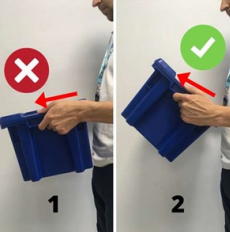
1. Avoid holding things in a way in which your thumb is pointing downwards. When your thumb is pointing down the effected tendons are being stretched which puts them under more strain.
Carrying with your thumb pointing upwards removes the stretch in these tendons and allows them to work in a position that they are particularly strong in.
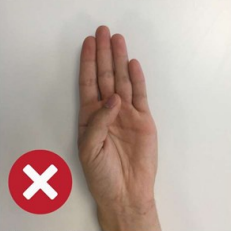
2. Try to avoid moving your thumb across your hand as this stretches the effected tendons and puts them under more strain.
Additionally try to avoid repetitive thumb or wrist movements and holding things using your thumb for long periods of time.
If you are in doubt remember to avoid painful movements with your hand as much as possible.
Thumb splint
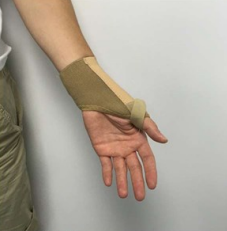
A thumb splint will assist in preventing unhelpful movements as described above. This can usually be provided by your physiotherapist. If this is not possible or you require a replacement they can be found by searching for a "SPICA splint" online.
Anti-inflammatory medications
Anti-inflammatory medications can help the tendons settle again. For some people taking anti-inflammatory medications can be unsafe,
usually as they can interfere with other medications. If you have any doubts whether you should take them please contact your GP.
Exercises
This guidance has been produced by the Dynamic Health physiotherapy service. It offers simple measures to help you manage your wrist problem safely. Often the right advice and exercises are all you need to improve the problem.
How much exercise should I do?
Exercise every other day
Allowing enough rest is important to let soft tissues recover and develop.
Choose 3 or 4 exercises
Choose exercises that are challenging but manageable.

Repeat the exercise
Perform 10 repetitions of each exercise.

Rest
Rest for up to 1 to 2 minutes between each set.

Once an exercise is easy, progress it
Increase the number of repetitions (aim for 10). Or hold the positions for longer or move to a more challenging exercise.
How much pain is too much pain?
Before exercising
Before exercising, rate your pain at the moment on a scale of 0 to 10, where 0 is no pain and 10 is the worst pain you can imagine.
A maximum pain level
A maximum pain level of 4/10 whilst exercising is fine as long as it eases within 45 minutes of the session and does not interfere with sleep or activities the next day.
If your pain increases
If your pain increases beyond this, simplify the exercise by reducing the range of movement or number of repetitions, or try an easier exercise.

Exercises for when your pain has settled
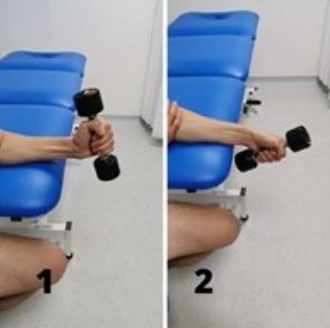
Exercises are not able to cure the problem in your thumb, however it is a good idea to complete them after your pain has settled in order to strengthen the involved muscles again and prevent the problem re-occurring.
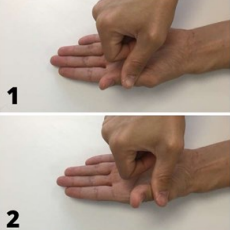
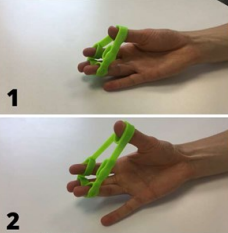
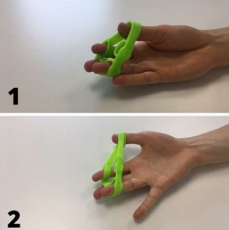
Try to repeat either the first 2 (no band), or last 2 (with the finger strengthener band) once a day for a period of 2 months. Stop the exercises if they become painful.
When you move onto the exercises using a resistance band, you can use standard elastic bands. However, specific finger strengthener bands are preferable.
We are not able to provide these ourselves however they are inexpensive and can be found online by searching "finger strengthening band".

Need more help?
Consider self referring using the link below
If you have a new injury or problem, please look at the self help information in our advice pages. We will often complete the same exercises and share information in clinic appointments.
If you still need some more help you can self refer into our service. Please note that the NHS is currently experiencing longer than normal waits, for more information visit our waiting times page.
