 Easy read and translate



Shoulder pain
Do you have shoulder pain?
The shoulder is the most mobile joint in the body; it moves the arm in different directions. And it’s because the shoulder joint is so flexible that it’s prone to various different types of injuries. One in three of us will experience pain at some time in our lives.
The pain can be caused through injury, repetitive activities or can often start without a specific cause. It is important to see your GP if:
- Your shoulder pain started following a fall or trauma.
- You have significantly restricted range of movement.
- There is any heat redness and swelling around the joint as this may be a sign of infection.
In many cases, you can treat shoulder pain at home using the advice and exercises detailed in our information below.
About shoulder pain
Watch the video for information about shoulder pain
Spotlight on shoulder pain
If you would like to see a demonstration of the exercises please watch our playlist. The playlist contains five exercises.
Please watch the introductory animation at the beginning of the playlist before you start.
Please select the arrow to view all videos in this playlist.
How to help shoulder pain
This guidance has been produced by the Dynamic Health physiotherapy service. It offers simple measures to help you manage your shoulder problem safely; often the right advice and exercises are all you need to improve the problem.
This information has been made available to your GP, who may ask you to try the advice and exercises prior to consulting a physiotherapist. If your shoulder pain started after recent trauma, please seek medical advice before reading further.
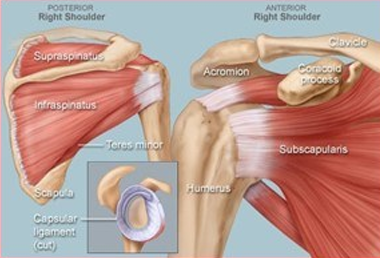 shoulder is the most mobile joint in the body and actually made of two joints.
How much exercise should I do?
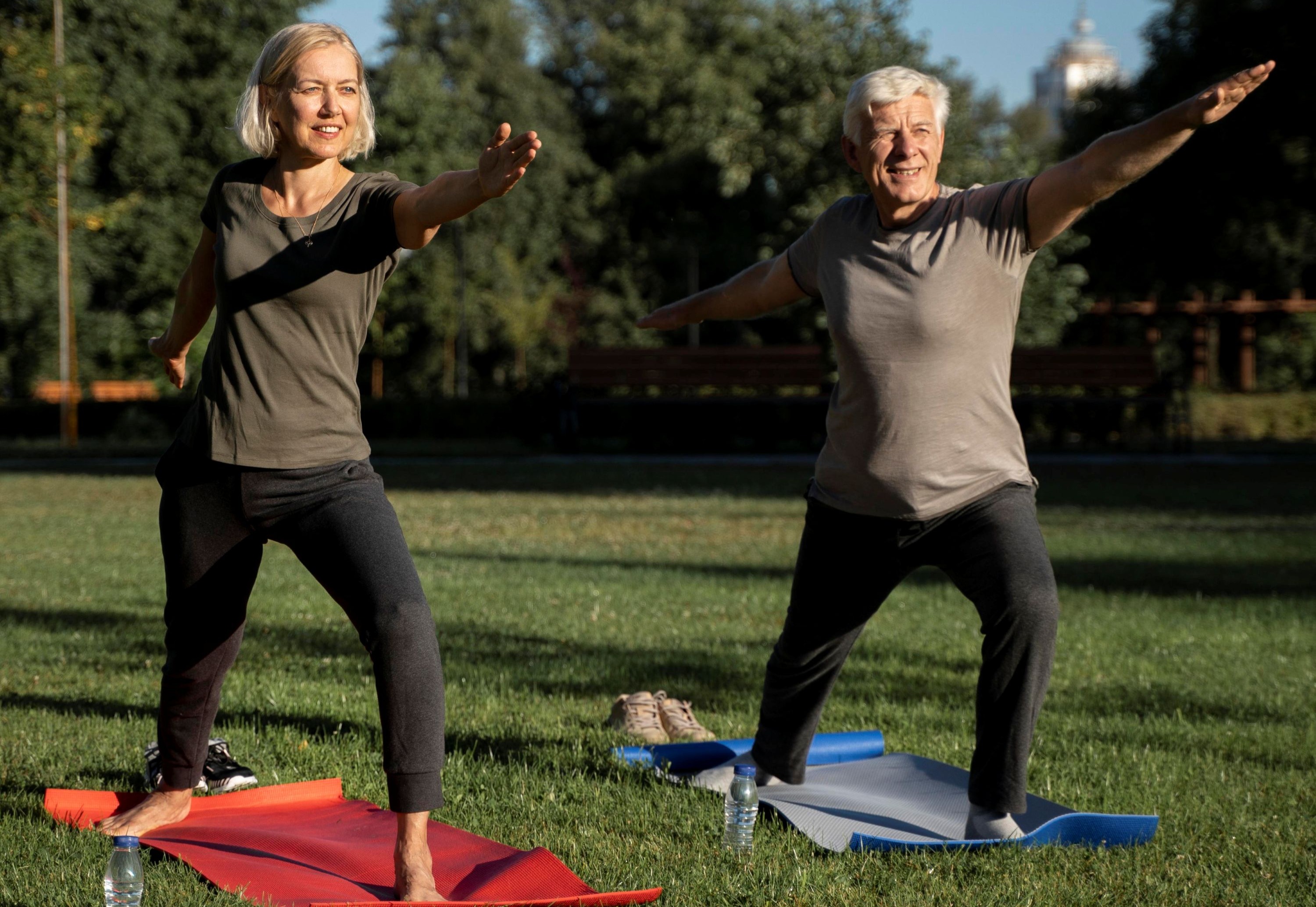
Exercise every other day
Allowing enough rest is important to let soft tissues recover and develop.

Choose 3 or 4 exercises
Choose exercises that are challenging but manageable.

Repeat the exercise
Perform 3 to 5 sets of 5 repetitions for each exercise.

Rest
Rest for up to 1 to 2 minutes between each set.

Once an exercise is easy, progress it
Increase the number of repetitions (aim for 10), hold the positions for longer or move to a more challenging exercise.
How much pain is too much pain?
Before exercising
Before exercising, rate your pain at the moment on a scale of 0-10, where 0 is no pain and 10 is the worst pain you can imagine.
A maximum pain level
A maximum pain level of 4/10 whilst exercising is fine as long as it eases within 45 minutes of the session and does not interfere with sleep or activities the next day.
If your pain increases
If your pain increases beyond this, simplify the exercise by reducing the range of movement or number of repetitions, or try an easier exercise.

Exercises
The following exercises do not need to be completed in any particular order and it can be helpful to try and gradually build your range of movement and strength at the same time. Choosing some challenging but manageable exercises from each section may be helpful.
Range of movement exercises
If your shoulder has lost movement because of pain or stiffness, it needs to be regained in order to strengthen the shoulder effectively.
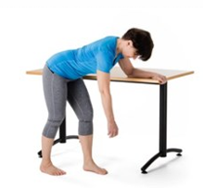 leaning on a table with your good arm. Let your other arm hang relaxed straight down. Gently swing your arm as if drawing a circle on the floor (the bigger the circle, the harder). Change direction. Aim for up to 30 seconds each way.
  or stand. Place your hands on a table. Slide your hands along the table as far as you can without lifting your shoulders very much.
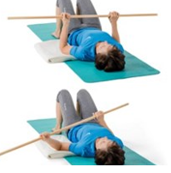
 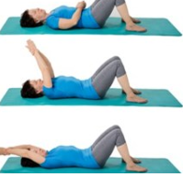 on your back. Use your good arm to lift the other arm up over your head. Then slowly relax back to the starting position.
  sit or stand with both elbows at right angles. Hold a stick with both hands. Keep your elbow near to your side as you use the stick and other hand to push the hand of the affected side outwards; your elbows should stay bent throughout.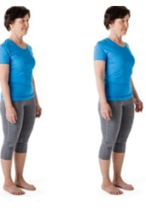
 and grip one end of a stick with the arm to be exercised. Lift your arm to the side, assist by pushing with the other hand. Then slowly relax back to the starting position. Repeat.
 Strength exercises
If your shoulder moves through its full range of movement in the previous exercises, please try some of these strengthening exercises.
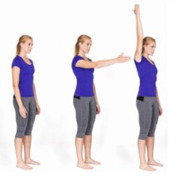 up straight with arms by your sides. Lift one arm forward and up with the thumb leading the movement. Lower the arm back to the starting position.
 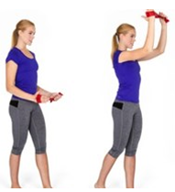 with one leg forward, your weight on the rear leg. Loop a band, knotted scarf/towel or looped belt around your hands. Move your weight towards your front leg. At the same time, bring your arms forwards and upwards while keeping the band tight. Keep your neck and shoulders relaxed. Bring the weight back to the rear leg and lower your arms to your side. Switch legs and repeat.
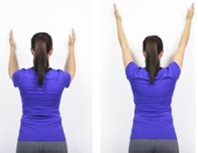 tall, facing a wall. Forearms against the wall with palms facing each other. Keep a neutral spine position – don’t arch your back. Lean towards the wall while sliding your arms upwards into a 'Y' position. Let your shoulder blades ‘push outwards' and keep your shoulders down. At the 'Y' position, lift your arms slightly off the wall. Lower to the starting position.
 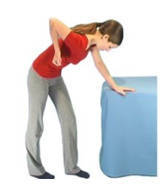 leaning on a table with one hand. Let your other arm hang relaxed straight down. Bend your elbow bringing it behind your back and pull your shoulder blades together. Hold a light weight in your hand to Increase the difficulty.
 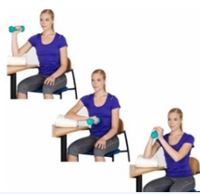 diagonally by a table. Bend your elbow and place it on the table. The elbow should be slightly in front of the body and slightly lower than your shoulder. Hold a weight in your hand with your hand pointing straight up. Keeping the elbow and shoulder in place, in a controlled manner, lower the hand forward. Return to the starting position using support from your other hand.
 Top tips
Read top tips on how you can help avoid or improve shoulder pain
- Try to build your exercises into your daily activities.
- You don’t have to do all the exercises in one go.
- Don’t feel you have to replicate the full movement of the exercise straight away. Use it as a guide, and build up gradually to the full movement over time.
- If a particular movement is painful, monitor your progress each week by seeing how this movement improves.
- It is normal for it to take 6 to 12 weeks before you notice an improvement in your pain, movement and strength, and it can take longer for complete improvement.
- Don’t stop moving your shoulder – muscles need movement to keep them healthy.
- General exercise can really help your recovery so try to keep going with other activities you enjoy to keep fit. Even a brisk walk could really help.
Avoid unhelpful postures
The best posture is the next posture – it is a good idea to take regular breaks from sitting or standing in the same position for a long time.
When you do need to sit for a while, try to avoid leaning forward with your arm held tightly by your side, which is a common “guarding” position in shoulder pain.
Unfortunately, it can make the problem worse, especially if some of the pain is coming from your neck. Sitting tall and supporting your arm on a cushion on your lap may be a helpful alternative.
Reducing the strain
While the shoulder is at its most painful, there are ways of adapting your movements to reduce the strain you place on it. For example, when raising your arm or lifting objects, try to reduce the strain on your shoulder by keeping your elbow bent and in front of your body (rather than out to the side).
It’s often more comfortable to keep your palm facing the ceiling too. To lower your arm, bend your elbow, bringing your hand closer to your body. Try to avoid or limit movements that are most painful, especially those that involve prolonged positions or pushing into an end range of movement.
Movements that are typically most aggravating are those that hold your arm away from your body, above shoulder height or behind your back. It is nonetheless important to remain active, even if you have to limit how much you do or the types of activity you do.
We encourage you, as pain allows, to try and restore full movements but gradually as you feel able.
Need more help?
Consider self referring using the link below:
If you have a new injury or problem, please look at the self help information in our advice pages. We will often complete the same exercises and share information in clinic appointments.
If you still need some more help you can self refer into our service. Please note that the NHS is currently experiencing longer than normal waits, for more information visit our waiting times page.
